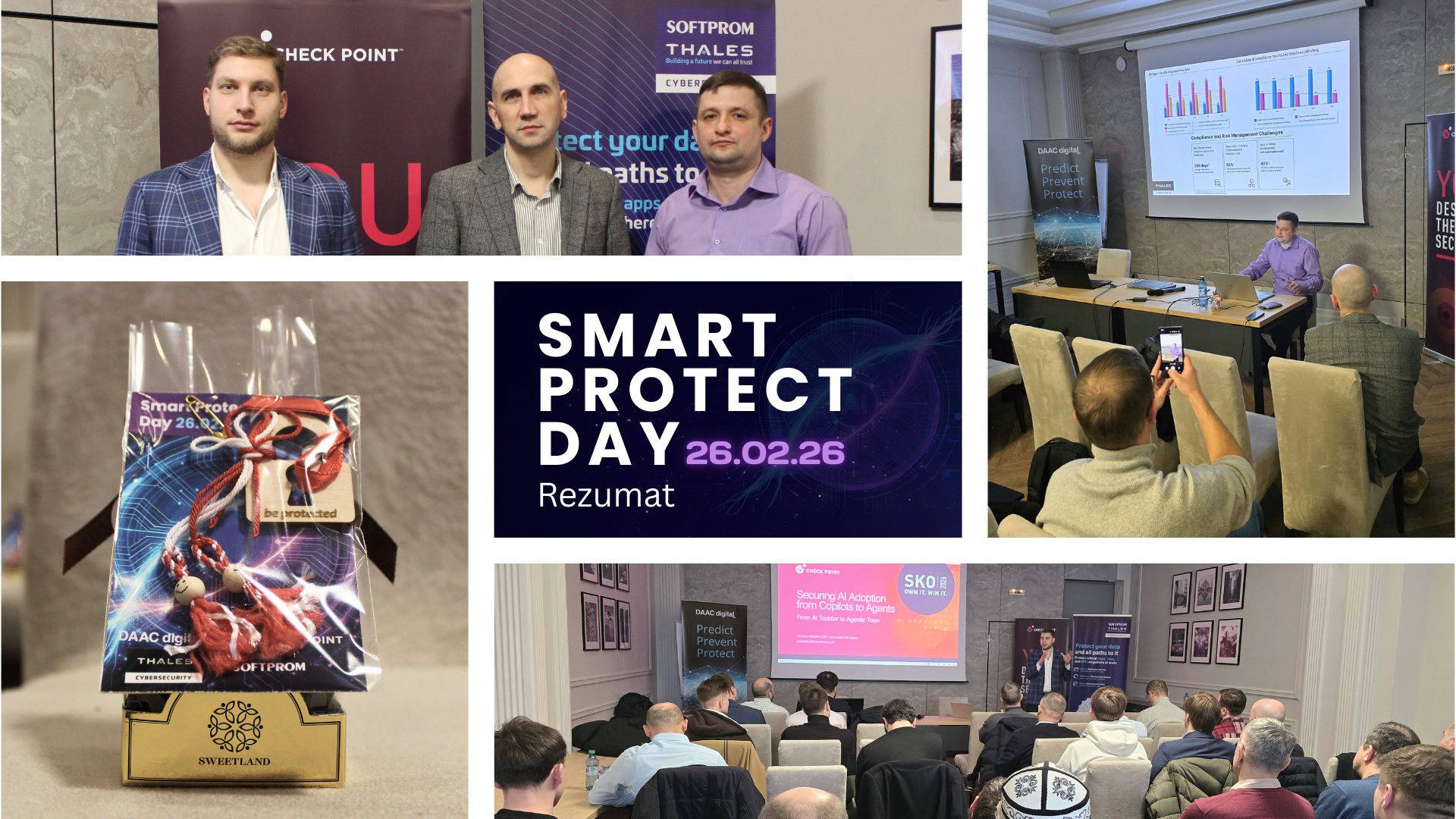
On February 26, 2026, Smart Protect Day took place at Regency Hotel – a focused meet-up on security at a time when AI is going deeper and deeper into how companies actually work. The event brought together complementary perspectives: from “why this is urgent” (real risks, not theory), to “how to secure AI adoption,” and finally to “how to protect data and applications when everything is becoming more connected.”
The day’s visible partners – DAAC digital, Check Point, and Thales/Imperva (together with Softprom) – set the tone: practical conversations, concrete examples, and takeaways you can bring back into your organization.
Speaker order and key takeaways
1) Alexey Shulenkov (DAAC digital) – “Why?”: because the risks are not hypothetical
The event was opened by Alexey Shulenkov with a short, clear, and straight-to-the-point introduction on why AI security is a topic for today, not tomorrow.
The core message was simple: as we use AI more often (in chats, applications, and everyday work tools), the number of scenarios where things can go wrong also grows – whether through information leaks, misuse, or attacks that exploit human behavior. In practice, we are no longer talking only about “a new tool,” but about a new way of working that can amplify both productivity and risk.
Alexey emphasized the idea of “operational reality”: some incidents become possible not because someone intends harm, but because workflows are fast, people trust AI, and controls are not always adapted. It was a strong starting point for the rest of the day: if AI enters your processes, security must enter with it.
2) German Khokhlov (Check Point) – Securing AI Adoption from Copilots to Agents
After the “why,” the program moved to the “how.” German Khokhlov (Check Point) spoke about the shift from copilots to agents – and how risks change when AI is no longer only an assistant that suggests, but can execute steps or influence decisions in business processes.
One point that resonated in the room was that “AI is everywhere”: in web apps, browser extensions, SaaS integrations, developer tools, and even desktop agents. The more places AI appears, the larger the “surface area” where issues can occur: uncontrolled access, exposed data, prompt injection, and shadow AI (usage outside company policies).
In plain terms: AI should be treated like a privileged participant. If it has access to data or systems, you need clear rules: what it can see, what it can do, what is logged, what is blocked, how to prevent accidental exposure, and how to keep visibility. The talk stayed practical and control-oriented: not “stop AI,” but adoption with protection and governance.
3) Grigoriy Badin (Softprom/Thales/Imperva) – Data protection in the age of AI
The final part of the day completed the picture from a critical angle: data. Grigoriy (Thales/Imperva) focused on how risks are rising quickly, compliance pressure is increasing as well, and in many organizations data is already spread across hybrid and multicloud environments – which makes control harder.
The key idea: access control alone is no longer enough. Organizations need data-centric controls (built around data, not only around the “front door”), plus strong protection at the application and API level – because that’s where information actually flows in real life. The discussion also touched on risk management and classic challenges: limited visibility, long time-to-detect incidents, shortage of specialists, and overloaded teams.
Atmosphere and conclusion
Smart Protect Day had a strong rhythm: concise talks, memorable examples, and an audience clearly connected to the topic. The Q&A and post-talk discussions highlighted a shared concern: how to keep AI adoption fast without losing control over data and risk.
The overall conclusion – reinforced by all three sessions – was clear: AI is no longer “a separate project.” It is becoming part of infrastructure and everyday workflows. And if we want to use it well, we need to adopt it with rules, visibility, and protection – from the user all the way to data and applications.
For detailed information about our cybersecurity solutions, please visit our dedicated page: Cyber Security.